Every delayed flight has a visible cause.
A weather event. A maintenance issue. A staffing shortage. A late-arriving aircraft.
Yet many operational failures have an invisible cause that rarely appears on a report: a breakdown of trust.
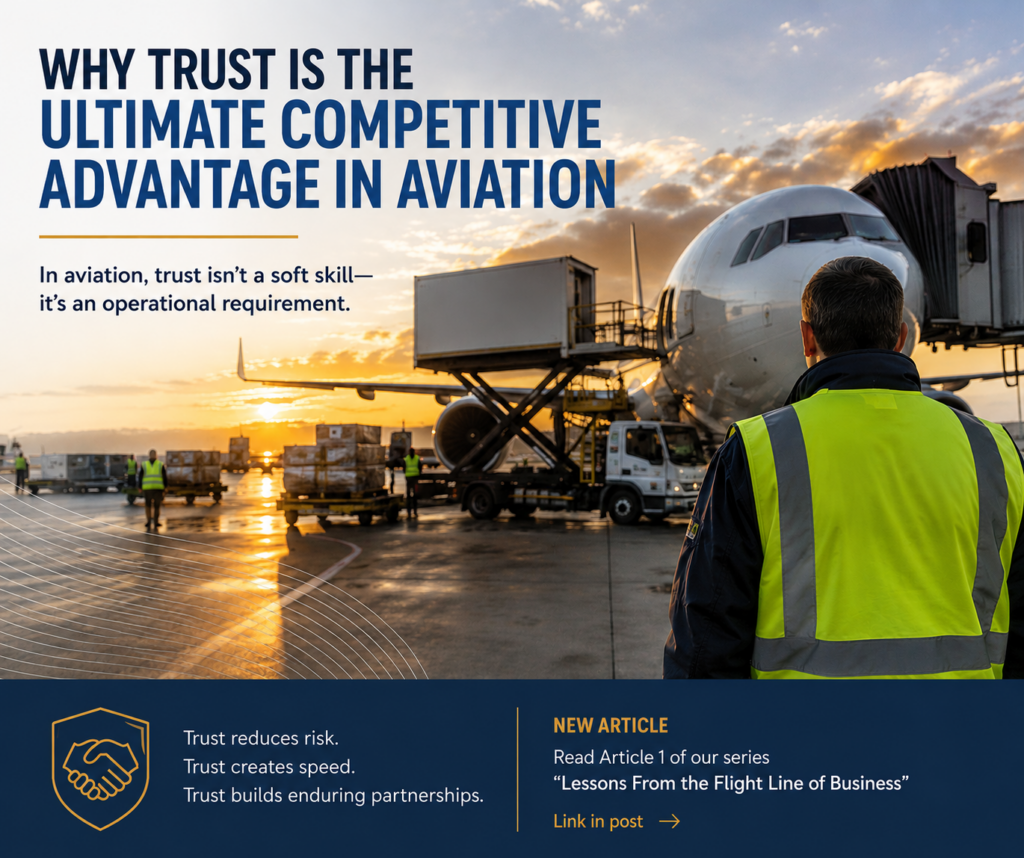
In aviation, trust is not a soft skill. It is an operational requirement.
Airlines trust caterers to deliver meals and service items on schedule. Catering operations trust suppliers to source products accurately and consistently. Procurement teams trust vendors to communicate challenges before they become disruptions. Ground operations trust their partners to do exactly what they said they would do.
When trust breaks down, costs rise, delays multiply, and relationships suffer.
The aviation industry provides one of the clearest examples of why trust remains the ultimate competitive advantage in business.
Trust Is Built Long Before It Is Tested
Most business relationships begin with promises.
A supplier promises competitive pricing.
A service provider promises responsiveness.
A partner promises reliability.
But trust is not built when things are easy. Trust is built when circumstances become difficult.
When inventory becomes scarce. When supply chains are disrupted. When transportation costs increase. When a critical product becomes difficult to source.
The organizations that earn long-term loyalty are rarely the ones that never encounter problems. They are the ones that communicate clearly, act responsibly, and remain accountable when problems arise.
Anyone can be a good partner when conditions are favorable.
The true measure of a partner is revealed when conditions are not.
Aviation Has No Margin for Excuses
Few industries operate with the precision requirements of aviation.
A delayed shipment can impact catering schedules. A missing component can affect operational readiness. A communication breakdown can create unnecessary costs throughout the supply chain.
In such an environment, excuses have limited value. Results matter. Preparation matters. Communication matters.
The most respected organizations in aviation understand that reliability is not simply about fulfilling orders. It is about reducing uncertainty.
Every procurement professional understands this reality: the lowest-priced option is not always the least expensive option. When delays occur, when products arrive incorrectly, or when communication disappears during critical moments, the hidden costs can quickly exceed any initial savings.
That is why trust often becomes a more important purchasing factor than price.
Trust reduces risk. And in aviation, risk reduction creates value.
Relationships Create Stability
Many companies view transactions as isolated events.
The best organizations view them as opportunities to strengthen relationships.
There is a significant difference.
Transactional thinking asks, “How do we win this order?” Relationship thinking asks a different question entirely: “How do we earn the next ten years of business?”
The aviation industry rewards organizations that think long term.
Airlines do not want suppliers who appear only when opportunities are abundant. They want partners who remain engaged during challenges. Catering operations do not simply need vendors. They need dependable resources capable of helping solve problems under pressure.
Procurement professionals do not merely purchase products. They manage risk, protect operational continuity, and support organizational performance. Strong relationships make each of those responsibilities easier.
When trust exists, communication improves. When communication improves, problems are identified earlier. When problems are identified earlier, solutions become easier to implement.
This creates a cycle that strengthens both operational performance and business growth.
Trust Creates Speed
One of the most overlooked benefits of trust is speed.
Organizations often assume speed comes from technology, automation, or scale. While those factors certainly matter, trust often accelerates business far more effectively.
When trust exists, decisions happen faster, approvals move quicker, and problems get solved sooner. Resources become more accessible. Opportunities move forward with fewer obstacles.
Low-trust environments work in reverse. More approvals, more verification, more oversight — friction compounding at every step.
The difference becomes particularly visible during supply chain disruptions. Organizations with strong supplier relationships gain access to information, alternatives, and solutions more quickly than those focused solely on transactional purchasing.
Trust becomes a competitive advantage because it improves responsiveness.
And responsiveness often determines success.
Reputation Is a Business Asset
Financial assets appear on balance sheets.
Reputational assets do not.
Yet reputation may be one of the most valuable assets a company possesses. Every interaction contributes to it. Every commitment influences it. Every response either strengthens or weakens it.
In aviation, reputation travels quickly.
Organizations become known for their responsiveness, their reliability, their professionalism, their communication — or the lack thereof.
Over time, these perceptions shape opportunities.
The strongest brands are rarely built through marketing campaigns alone. They are built through consistent performance, one fulfilled commitment at a time.
What This Means for Business Leaders
Whether you support airlines, catering operations, government agencies, or commercial enterprises, the lesson remains the same.
Products matter. Pricing matters. Capabilities matter.
But trust amplifies the value of all three.
Companies that consistently communicate, follow through on commitments, and prioritize long-term relationships position themselves for sustainable growth.
In an increasingly competitive marketplace, trust remains one of the few advantages competitors cannot easily replicate.
It takes years to build. It takes discipline to maintain. And when cultivated properly, it becomes a foundation for enduring success.
Final Thoughts
The aviation industry depends on thousands of moving parts working together seamlessly.
Behind every successful operation is a network of organizations that trust one another to perform.
That lesson extends far beyond aviation.
The businesses that thrive over the long term are not always the largest, the oldest, or even the lowest cost.
They are often the most trusted.
At Inflight Supplies & Service, we believe successful aviation operations are built on more than products and procurement. They are built on trust, responsiveness, and relationships that endure long after a purchase order is fulfilled.