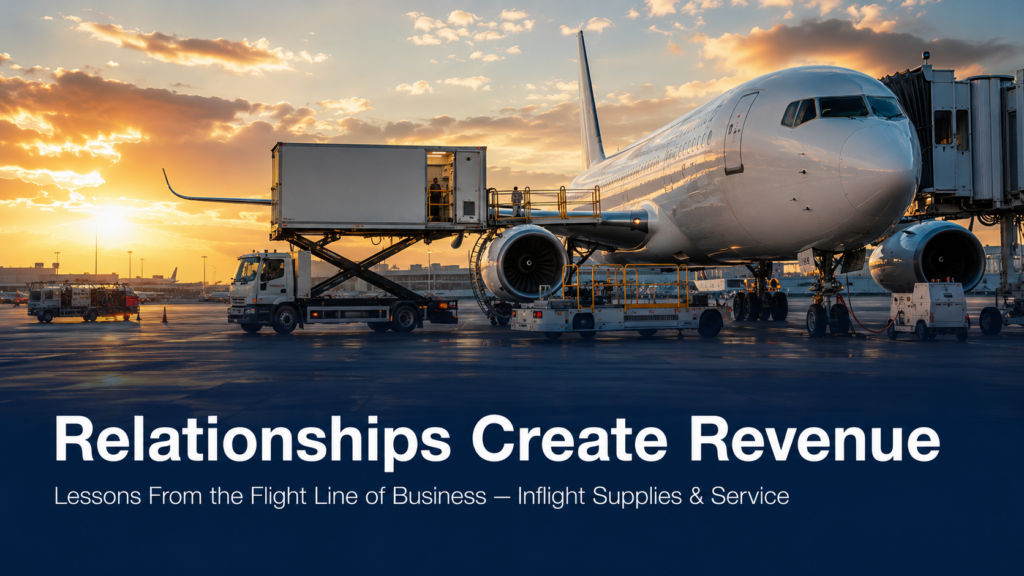
Aircraft do not operate in isolation.
Neither do successful businesses.
Every flight depends on a network of suppliers, caterers, service providers, logistics partners, procurement teams, and operational personnel working together toward a common objective: delivering a safe, efficient, and reliable experience.
When passengers board an aircraft, they see the airline’s brand.
What they do not see are the dozens of organizations working behind the scenes to make that flight possible.
The meals were sourced, prepared, and delivered by dedicated catering teams. The onboard service items were procured through a network of suppliers. Ground operations coordinated logistics. Maintenance professionals ensured readiness.
Countless relationships contributed to a single successful outcome.
The same principle applies to business.
While revenue may appear on financial statements, it is often created through relationships long before it appears on an invoice.
In aviation, as in business, relationships create revenue.
Revenue Follows Relationships
Many organizations focus heavily on sales strategies, marketing campaigns, and pricing models.
While all of these matter, they often overlook a simple reality: people prefer doing business with organizations they trust.
Revenue is rarely generated by a single transaction. More often, it is generated by a series of positive interactions that build confidence over time.
A procurement manager remembers a supplier who responded quickly during a critical shortage. A catering operation remembers a partner who found a solution when inventory became difficult to source. An airline remembers the vendor who communicated proactively during a disruption rather than waiting for problems to escalate.
Those moments create trust. Trust creates confidence. Confidence creates opportunities. And opportunities ultimately create revenue.
The organizations that consistently invest in relationships often discover that growth becomes a natural byproduct of the value they provide.
Trust Accelerates Revenue
Many organizations treat trust as a relationship benefit — something that makes business more pleasant.
The most successful organizations treat it as a revenue driver.
When trust exists between a supplier and a customer, something changes in how business actually moves. Renewals happen without a competitive bid process. New requirements get brought to a trusted partner first, before they ever become a formal opportunity. Budget conversations happen earlier, because the relationship has already earned a seat at the table.
In aviation, this plays out in concrete terms. A catering operation facing a last-minute product need calls the supplier they trust — not the one with the lowest catalog price. An airline procurement team expanding a program brings in their most reliable partners before issuing a broad solicitation.
Trust does not simply support revenue.
It redirects it.
Strong Partnerships Create Operational Advantages
Successful aviation operations are built on coordination.
Airlines depend on caterers. Caterers depend on suppliers. Suppliers depend on manufacturers. Every link in the chain influences the final outcome.
When partnerships are strong, operational performance improves. Information flows more freely. Potential problems are identified earlier. Alternative solutions become available faster. Teams work together to achieve common goals.
These advantages are particularly important during periods of disruption. When supply chains become constrained, strong partnerships often determine who gains access to inventory, resources, and solutions first. Organizations with trusted relationships frequently discover that partners go the extra mile because the relationship extends beyond the transaction.
That is not merely good business. It is a competitive advantage.
Why Transactional Thinking Limits Growth
Many businesses approach every interaction with a simple question: “How do we win this order?”
The most successful organizations ask a different question: “How do we earn this relationship?”
There is an important distinction.
Transactional thinking focuses on immediate results. Relationship thinking focuses on long-term value. The challenge with transactional thinking is that it creates a cycle of constant replacement — organizations are always searching for new customers and new revenue sources because they have not fully developed the relationships they already possess.
Relationship-focused organizations operate differently. They understand that repeat business is often more valuable than new business. They recognize that referrals are earned through performance. They understand that reputation compounds over time.
Sustainable growth is built through trust, not transactions.
The Long-Term Value of Relationships
The strongest business relationships are not measured in months.
They are measured in years. Sometimes decades.
Throughout the aviation industry, some of the most enduring partnerships have survived market shifts, economic downturns, supply chain disruptions, and operational challenges. Why? Because the foundation was built on something more durable than price — reliability, consistency, communication, mutual respect, and shared success.
These relationships become increasingly valuable over time because each successful interaction strengthens confidence. Each challenge overcome together deepens trust. Each commitment fulfilled reinforces credibility.
Over time, the relationship itself becomes an asset — one that generates opportunities, creates stability, and supports growth.
Small Actions Build Great Partnerships
Many organizations assume strong business relationships are built through major initiatives.
In reality, they are often built through small actions repeated consistently.
Responding promptly. Communicating honestly. Following through on commitments. Providing solutions instead of excuses. Taking ownership when challenges arise. Showing appreciation for the partnership.
These actions may appear simple. Yet they are surprisingly rare. Organizations that consistently execute these fundamentals often distinguish themselves from competitors who focus exclusively on price or transactions.
Relationships grow when trust is reinforced through action.
What This Means for Business Leaders
Whether you support airlines, airline caterers, aviation service providers, or commercial enterprises, the lesson remains the same.
Growth is not solely a function of products, pricing, or marketing. Growth is often the result of strong relationships built over time.
Business leaders who invest in trust, communication, responsiveness, and long-term partnerships position their organizations for sustainable success. They create networks of people who want to work with them, recommend them, and support them. In an increasingly competitive marketplace, that advantage becomes very difficult to replicate.
Final Thoughts
The aviation industry offers a powerful reminder that no organization succeeds alone.
Every successful flight depends on a network of trusted partners working together toward a shared objective. The same is true in business.
Products, technology, and facilities all matter. But the most valuable asset behind any successful aviation operation is rarely listed on a balance sheet.
It is the strength of the relationships behind it.
Think about your most valuable business relationship today — what originally built the trust that made it what it is?
At Inflight Supplies & Service, we believe lasting success is built through trust, responsiveness, and partnerships that create value for everyone involved. In aviation, as in business, strong relationships do more than support operations — they create opportunities that drive long-term growth.