Most procurement decisions are measured by price.
The best procurement decisions are measured by outcomes.
In aviation and airline catering, a product that arrives late, arrives damaged, or fails to meet specifications can cost significantly more than the savings generated during the purchasing process. On paper, choosing the lowest-priced supplier often appears to be the responsible decision. Procurement teams are tasked with managing budgets, controlling costs, and delivering value to their organizations. However, experienced aviation professionals understand that the true cost of a procurement decision extends far beyond the purchase order.
The real question is not, “What did we pay?”
The real question is, “What did it cost us?”
In an industry where timing, reliability, and operational continuity are critical, the difference between those two questions can be substantial.
Lowest Cost Versus Lowest Total Cost:
One of the most common mistakes organizations make is confusing the lowest price with the lowest cost.
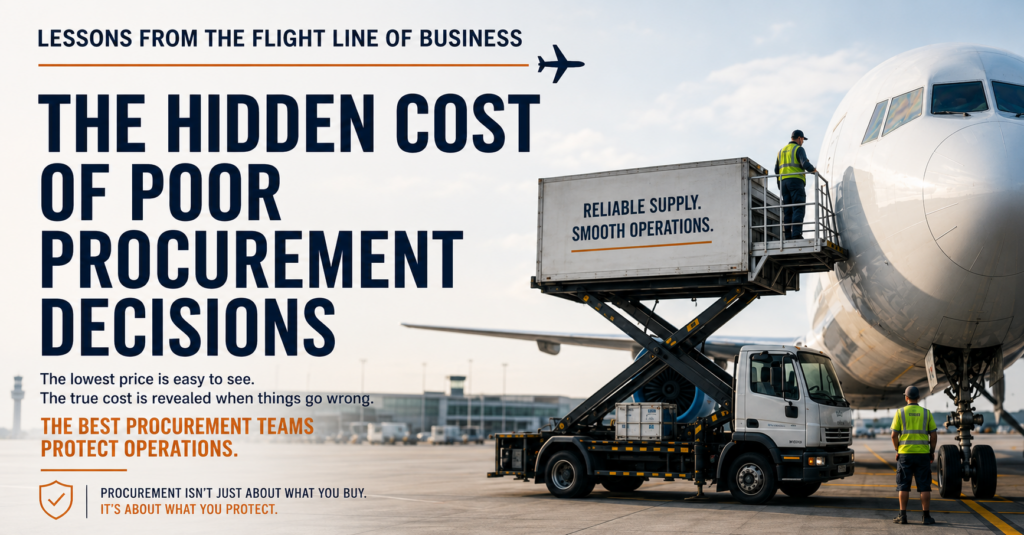
The lowest price is easy to identify.
It appears clearly on a quote, proposal, or invoice.
The lowest total cost requires deeper analysis. Consider a supplier that offers a product at a lower price but struggles with delivery consistency. A late shipment may force an airline caterer to source replacement products at premium rates. A missing component may require expedited shipping. An inventory shortage may create operational disruptions that impact service quality. Suddenly, the savings achieved during procurement disappear. In many cases, they are replaced by additional costs that exceed the original price difference. The most effective procurement professionals understand that value is measured by the complete outcome, not simply the initial transaction.
The Hidden Costs Nobody Calculates:
Many operational costs never appear on a procurement report. They show up in operations, in customer service, in logistics, in employee productivity, and in client relationships — often long after the original purchasing decision has been filed away. A supplier that consistently misses deadlines creates a chain reaction of inefficiencies. Teams spend additional hours following up on orders. Managers spend time resolving issues that shouldn’t have escalated. Operations personnel develop contingency plans that exist only because a vendor couldn’t be relied upon. Leadership gets pulled into problem-solving that should never have been necessary. Each individual cost may appear small. Collectively, they become significant. The challenge is that these costs are often invisible until they begin affecting performance. By that point, the organization has already paid the price.
Downtime Is Expensive:
Few industries understand the cost of downtime better than aviation. Aircraft schedules are built around precision. Catering operations depend on timing. Ground support services operate within narrow windows of opportunity. A delayed product shipment can impact an entire sequence of activities. A missing service item can require last-minute substitutions. An unavailable component creates operational uncertainty that ripples through the day. The true cost of a procurement decision is often revealed when something goes wrong. The supplier that appeared expensive on day one may become the least expensive option when measured over the life of the relationship.
Emergency Sourcing Comes at a Premium:
Every procurement professional has experienced it. A critical product becomes unavailable. An expected shipment fails to arrive. An operational requirement suddenly becomes urgent. The organization enters emergency sourcing mode. Emergency sourcing almost always costs more. Products need to be expedited. Alternative suppliers charge premium pricing. Additional labor is required to locate available inventory. Internal teams are forced to redirect their attention from strategic work to immediate problem-solving. The cost of the original purchasing decision suddenly becomes much larger than anticipated. Preparation is almost always less expensive than reaction.
The Value of Strong Supplier Relationships:
Procurement is often viewed as a process. The most successful organizations view it as a relationship. Strong supplier relationships create advantages that cannot always be measured on a spreadsheet. Trusted suppliers communicate proactively, identify challenges early, offer alternatives when disruptions occur, and leverage their networks to locate difficult-to-source products. They become problem-solvers rather than order processors. This distinction becomes particularly important during periods of supply chain disruption. When inventory is constrained and demand increases, relationships matter. Organizations that have invested in strong supplier partnerships often gain access to information, inventory, and solutions more quickly than those focused exclusively on transactional purchasing. The best supplier relationships create value long before an order is placed.
Why Responsiveness Matters More Than Price:
Price matters. Every organization must manage costs responsibly. However, responsiveness often creates greater long-term value. When challenges arise, responsive suppliers provide clarity — they communicate quickly, offer options, take ownership, and help customers make informed decisions. Unresponsive suppliers create the opposite: uncertainty leads to delays, delays create risk, and risk creates cost. For airlines and airline caterers, responsiveness can be the difference between a manageable situation and a significant operational disruption. The ability to quickly identify solutions often delivers more value than a marginal price difference on a purchase order.
Procurement as Risk Management:
The most effective procurement professionals understand that their role extends beyond purchasing. They manage risk. They support operational continuity. They protect customer experience. They strengthen organizational resilience. Every supplier selection decision influences those outcomes. The best procurement teams evaluate more than products and pricing — they evaluate reliability, communication, responsiveness, and long-term value. These factors often determine whether an organization thrives during challenging conditions or struggles to adapt.
Final Thoughts:
In today’s aviation environment, procurement decisions carry consequences far beyond the purchasing department. Every decision influences operations, customer service, logistics, and organizational performance. While competitive pricing remains important, successful organizations understand that the lowest bid does not always produce the best result. The true measure of procurement success is not how much money was saved during the transaction. It is how effectively the decision supported operational goals, reduced risk, and created long-term value.
The best procurement professionals do not buy products. They protect operations.
Has your organization ever discovered the real cost of a procurement decision long after the purchase order was signed? What triggered that realization?
At Inflight Supplies & Service, we understand that successful procurement is about more than sourcing products. It is about delivering reliability, responsiveness, and solutions that help airlines and aviation service providers keep operations moving forward with confidence.